Tuesday, April 29, 2014

Ιωάννινα, a lake-side town

Spending 3 months in the Zagori mountains means I also spent some time in the capitol of the region, Ιωάννινα. In English, Ioannina. Some people pronounce it "yawn-ee-na" and others "yo-awn-ee-na" and others even put a gamma (g/j) in front! The name means "city of John" or something to that effect. Regardless the name is deceptively simple. About 1 hour down the mountain from Papigo, Ioannina is where Nefeli and Atho go to school and where I go if I need to replace items or visit a doctor, etc.

Four years ago I went there with my mum and sister but it was all by the seat of our pants. This time I was able to spend quite a few afternoons in Ioannina and got to retrace out steps from 2010 and explore the city at will.

_________


Lake Pamvotis

The city is on the lake Pamvotis (Παμβώτις) and is often foggy because of it! Originally founded by Justinian in the 6th century, Ioannina began as an Byzantine city (meaning it was eastern-Roman if you will). Justinian was one of the last emperor to speak Latin officially and sought to win back and revitalize the western Roman empire. Ioannina flourished as a Byzantine city but was conquered by the Ottomans in the 1430. It was not until 1913, after the Balkan wars, that Ioannina became part of Greece. Their independence day is February 21st! Ioannina has a rich history as a city of enlightenment and the city has always been home to a large Jewish population (since the 1st century CE) as well as Muslim communities.

The citadel, located on the lake side and built up like a small acropolis, is an historical castle fortress that is easy to get lost in (apparently intentional to help capture enemies) and has museums and private homes. Inside you can see the Byzantine museum, Aslan Pasha Mosque, and the Ethnographic Museum. The citadel is usually quiet so it is a peaceful place to walk and see the city and lake. You may get lost, though, as I said the alleys are winding and more than a few of them lead to dead ends!
 Street in the citadel/fortress/castle!
 Walls of the citadel
Ethnographic Museum on the left (with very tiny, short doors) and the mosque is on the right. There are monuments/shrines to wars throughout the courtyard here.


The historical area of Ioannina is home to cafes, shops, bakeries, and two places I miss already: Motley and a dried fruit and nut shop. I first went to Motley with Katerina, Clara, and her family just before Christmas. Needless to say that on (nearly) every trip back to Ioannina following I stopped by Motley and slowly went through their menu.

For me, Ioannina turned into the place where I go to have a slow paced (but a little productive), coffee and sweet induced day full of "me time" and maybe meet a friend. I certainly was not able to see all of it, being on foot, but I now know that there is a biking/running path along the lake to check out for next time!


Sunday, April 6, 2014

Way up high in the Greek sky

Saffron, Talenn, and I set off to continue our Greek adventures on a Sunday after two full days of rain made working in the fields impossible.  We decided to head towards Delphi and from there go our separate ways.  We chose to travel during Carnival which may not have been very wise.

Taking a bus from Pyrgos to Patra (the supposed original carnival) we planned on catching a bus to Delphi. Planned.  Things that led to lots of sitting about and being generally unsure included: KTEL dropping us off at a small downtown stop that I did not recognize. There are two smaller stations and we had to find the other one for the Delphi connection. Wrong!!Also,  on Carnival Sunday there are no buses running to Delphi! Instructions after that were complicated and involved lots of town/port names we did not know. Back to original small bus station. We decided, after asking a few times if all buses were running, to go to Amfissa and then Delphi. It was quite a long day!
 Patra was bustling and decorated for the parties of Carnival! Floats could be seen hiding away until parade time and there were lots of these statues in all shapes and sizes!
 Square in Patra we found after wandering about being generally unsure what we should do for travel.
Doing all the heavy lifting of travel.

Δελφοί - Delphi - Delfoi
Located just south-west of Mount Parnassus (home to the Muses), on a spur of the mountain, lies Delphi.  The mountain-side sanctuary overlooks the Gulf of Corinth and its own modern town.  While it is very touristy, Delphi is one of those places in Greece you cannot miss.

The location of Delphi, which housed the Delphic Oracle, Pythia, is said to have been chosen by divine means. According to myth, Zeus loosed two eagles (one eastward and one westward) and where they met was the center of mother earth (Gaia). There is an omphalos (meaning navel) stone to mark the spot. An oracle in the center of the Greek world.  
This is the stone omphalos used to mark the spot where Zeus' eagles met. The carvings are of a knotted net. There is also a link to Rhea and Cronus (parents of Zeus) that this stone may have been the very stone given to Cronus by Rhea instead of Zeus.*

Apollo, to whom Delphi was dedicated, is said to have killed a python who protected the omphalos.  The oracle is known as "Pythia" and an epithet for Apollo is "Pythian Apollo". These names derive from this myth. Oracles were always female and they presided over the most important sanctuary in Ancient Greece. Apollo spoke through them.
What's left of the temple to Apollo. This is where the oracle did her thing!

Delphi was also the home of the Pythian games**. Held every four years it was one of four Panhellenic games - Pythian, Isthmian, Nemean, and Olympic.  Pythian games honored Apollo and were held in Delphi. The Isthmian games honored Poseidon and were held Isthmia, the Nemean games honored Hercules and his father, Zeus and were held in Corinth and Nemea. The Olympic games, of course, honored Zeus and were held in Olympia.  The games were originally for music and art (Apollo was a flute player, patron of the Muses, music and poetry among his other roles). Later chariot races and other athletic games were added.  Winners were given wreaths of laurel, Apollo's sacred tree. ***
 Stadium for races, located above the temple
Theater used for music and the arts

Delphi was more than most religious temples and games sites. Delphi was one of the richest sanctuaries and most visited by powerful men.  Delphi had treasuries lining the streets that represented various towns and cities - the Athenian and Siphnian are the most famous.
Saffron and the Athenian treasury. During use, the treasury would have been full of amphorae and other jars, statues, tripods, and other offerings to Pythia and Apollo
A remodeling of the Siphnian treasury. Arguably the most elaborate treasury, there were Caryatids (or Kore used as columns. Kore are female statues), four friezes, and a detailed pediment. The Siphnians were lucky enough to have silver and gold mines to garner their wealth.

If you ever get a chance to visit Delphi be sure to also visit the museum which has more of Delphi inside along with plans and a map of what it looked like.  Further down the mountainside lies the gymnasium (closed this time around) and a tholos (round temple) to Athena. Personally the Tholos is my favorite and it is quieter and not as often visited by the hoards of tourists and school buses. Beware - there are always school trips! 

After a misty morning and nicer afternoon, we were able to enjoy modern Delphi. It is small and easy to navigate. Many restaurants cater to tourists so the food can be passable. We ate at a place called Epikouros and it was amazing.  AMAZING.


Μετέωρα - Meteora
After Delphi we split ways - but we both made our way to Meteora. Monasteries in the sky! I spent only one night in Kalambaka just shy of the rock towers and I am very happy I did. I will have to visit again, though!
 View of Kalambaka from my small hike. The rock formations around me are not topped with monasteries (at least not any longer)
 A triangular square complete with flowing fountain. One of a few in the town. Everywhere you look you can see the rock formations jutting toward the sky.

Meteora in Greek means something long the lines of "in the air". There were once 24 but there are only 6 monasteries remaining and in use. They are: Great Meteoron, Varlaam, Rousanou, St. Nicholas Anapausas, St. Stephen, and Holy Trinity.  I visited the Grand Meteoron and Varlaam.
Grand Meteoron

In some of the monasteries women are not allowed. They are still lived in, preached in, and old to the old customs of the Greek Orthodox church. In Varlaam I had to put on my jacket to cover my arms and wear a wrap skirt over my jeans. It was a hot day for all of that.
 Varlaam and some rock mountains.
 Inside Varlaam looking at their bell tower - there was a monk cleaning the church while I was visiting.
 Spring time is very beautiful here
These tracks and crates are used for transporting goods to and from the monastery. Before the stairs were cut for easier access and tourism, there were ropes that the monks would climb as well as a pulley system. If you had any fear of heights this would not have been the place to be back when!

The scenery at Meteora is unlike anything I've seen in my travels. I began the day by hiking for an hour behind Kalambaka to get a view of the rock formations and the small city below. Afterward I hired a cab to take me up to Grand Meteoron (from there Varlaam is easily walkable). I hope to come back and hike up but I had a bus to catch in the afternoon!
____________

* Rhea (Titan goddess of fertility) and Cronus (or Kronos, Titan god of Time) had 6 children. They were Hera, Hestia, Poseidon, Hades, Demeter, and Zeus. Zeus was the youngest of their children.  Cronus was jealous of his own offspring and wanted to remain in power so he swallowed them (Cronus had taken power from Uranus by force).  Rhea was able to trick Cronus out of swallowing Zeus by giving him a large rock wrapped in swaddling. This rock is said to be the omphalos. 

Zeus was taken away to Crete and raised one goats milk (and by the goat, really). When he was older he returned and was able to save his siblings from Cronus' belly. They revolted, banished the Titans, and rose to Mt. Olympus to rule as the Greek Gods.

The omphalos reappearing when Zeus located Gaia's center at Delphi is symbolic of Zeus' own power and claim on the earth.

** The Pythian (or sometimes Delphic) games were as sacred as the Oracle. The games took place around the Olympic games - 2 years before and after. The games lasted for 3 months and were such a large part of the culture that there was the "Delphic Peace" which allowed competitors and spectators from all over Greece to participate regardless of current politics.  The revenue from the games along with the city-state treasuries made Delphi one of the richest places in all of Greece.

*** Laurel, or "Daphne" in Greek, is sacred to Apollo. Daphne was the daughter of a river god. Apollo was struck by one of Eros' (Cupid) golden arrows and Daphne was struck with a lead-tipped arrow. Gold made someone fall helplessly in love and lead caused the opposite reaction.

Apollo chased Daphne endlessly and, afraid of being caught, asked her father for help. Her father changed her into a laurel tree. Apollo was still infatuated with Daphne and so took the laurel to be his sacred tree. He often wore a crown of laurel.

__________

 Looking into the Gulf of Corinth from one of Delphi's touristy streets
 At Athena's tholos
 The new type of caryatid!
 Post-Delphi snacks! Most cafes here can boast a panoramic view of the Gulf, mountains, olive grove and almond trees in the area
And a throwback from 2010 with Mum and Kate!

North Americans Abroad

I decided to leave Papigo for a few weeks in order to see more of Greece and meet some new people.
I had been communicating with a man living near Ancient Olympia about his family farm. He has olive trees, grape vines, and bean fields.  My plan was to stay with Vasillis for about 2-3 weeks and take a small tour of the Peloponnese. Upon arrival back in Ioannina,I hoped to rent a car for a few days and see other villages, Meteora, and whatever other places I could find in suitable day-trip distance.

On February 21st I left Papigo, had coffee and dessert in Ioannina with Katerina, and took a bus to Pyrgos. It just happens that the 21st is Ioannina’s Independence day from the Ottoman Turks, so 1) it’s a miracle Katerina found me in the crowd and 2) it was cool to see.  I even went to Café Trois and said goodbye to Nikos (my last minute Valentine whom I met on said day at said cafe. I got wine and a balloon).
The building is something official - there is military stationed at the doors regularly. These guys were marching in a parade of sorts - the large crowds are up ahead but I had trouble getting through with my backpack...never mind a camera!

Keepsake...fantastic cafe, by the way. Cafe Trois.
_____

Buses are the way to get around in Greece. While they can be tedious and long, at least Greece offers some stunning scenery. The ride to Pyrgos was almost 7 hours. 

Vasillis was waiting for me at the bus station – tall and lanky, he was quick to whisk my backpack away and carry it to his car for me. Awesome. The ride home was not so awesome – holy smoke. Literally, smoke. Chain smoker extraordinaire, it seemed his car was really an ashtray with wheels. We did some shopping, stopped by the butcher (a good friend of his and during my stay I realized how strategic and delicious that could be), drank some tsiporou, and headed home for dinner. He has two dogs at the house, both puppies - Hermes, a 6 month old white and black pit bull and Hera, a bouncy, hyper Belgian Shepherd.
Two puppies who love to play!

Regardless of his smoking and cleaning habits (inside the house, not personal), Vasillis is an amazing cook. He loves the food he grew up on and wants to share it with everyone he encounters. He uses his own olive oil and we drink his wine at meals. His oil is sublime, all organic, and cloudier than most as he does not strain all the particles out - its unfiltered. His wine is far better than I expected – a white variety of grape that apparently yields less than most but is better for taste. It was sweet, not too dry, and went down easy! I became the salad prep girl and find myself wishing I had taken photos of his finished dinner spreads.
 Making dinner in the fireplace! Better than a grill and the house smells amazing, too. Beefteki (essentially a kafta kebab or Mediterranean spiced, grilled meatball) basted with olive oil, oregano, and lemon. Best dinner ever....until the next nights!
Just a simple lunch....chicken slow cooked with potatoes, salad, and wine. The chicken was crazy tender and juicy. 

The next day a couple joined me at the farm, Saffron and Talenn Shaffer, newlyweds from British Columbia, Canada.  They are on a 6 month honeymoon trip that began in Israel and will end in Germany.  We became fast friends.  Work with Vasillis consisted of trimming olive trees, piling and burning the trimmings, clearing bean fields (ripping up the plastic, old vines, and tilling the fields, laying fresh plastic), planting the seeds in the greenhouse and planting them a couple weeks later, and dishes. We provided our own breakfasts for the week, cleaned the dishes, and Vasillis stuffed us full between morning and afternoon work.
 The view from the bean fields. The sheep came in around 11:30 and grazed for an hour or so...some of the sheep make very scary noises. Yet it is so idyllic.
 
Hanging out in an olive tree with Hermes!!! Climbing and trimming the trees was really cool. Olive trees are cool.

The work was dirty and sometimes frustrating but certainly gratifying. We were sights to see at the end of the days and after showers we usually walked to the village or beach (both about a 30 min walk).
 Saffron found a gigantic earth worm in the field! Actually, she found many but we think this is the largest.
At the end of the day we were very dirty...our hands, and boots, and clothes are caked with mud. I feel I have grown as a person because I saw that I was sticking my hands into bug and spider infested dirt...and I never flinched.

Saffron and I both battled smoke headaches in the house and dealt with discomfort at the Mediterranean (southern Greece? Small village full of older men...? Likely) lack of personal space. It helped not being the only girl. Talenn scared Hermes the dog, became an expert Greek coffee maker (Nescafe and a little blender) and we all played lots of cards! Vasillis taught us a fun game called Biriba (or something to that effect) that none of us will ever be able to score correctly and that requires 4 players. We taught him Crazy Eights. Saffron got me addicted to “The Walking Dead", and I caught up on "Revolution".
 A stop along the walk to the beach!
 We had hoped to find a field of red poppies...and there were some but not in abundance. These weeds make beautiful fields of flowers! Saffron and Talenn.
 Beach! 
Vasillis has 700 olive trees.

____________

Saffron, Talenn, and I left the village area of Skafidia together and I decided to join them on their trip to Delphi.  Even though there were other places I wanted to see in Greece and even though I have seen Delphi numerous times, the idea of passing on the companions I had made seemed silly.

While my time in Skafidia was sometimes strained, I still enjoyed the work and my knowledge on the subject has increased drastically. I had a lot of fun with the dogs and meeting Saffron, Talenn, and Vasillis. One thing is for sure, he will introduce you to everyone! And being a close friend of the butcher has its perks – we ate the best meat and homemade sausages I have ever had. They are generous people who want you to learn and integrate into their culture.

καλή όρεξη - Kali Orexi! 

 Really awesome gate. There is a layer of treble celf''s and half notes!
 Talenn and Hera
 Proud of our bonfire building skills and trying to avoid all the brambles. And I'm getting sunburned.
 Proud man and his shovel for the evil pricker weeds
Self portrait...there were 6 I believe but this one turned out ok.

Friday, April 4, 2014

Hiking in Zagori

Nestled between mountain peaks in the Pindus mountain range, the villages of Megalo and Mikro Papigo are, without a doubt, two of the most picturesque and quaint villages in Western Zagori.  They are full of buildings - mostly homes, guesthouses and tavernas - that are built using local materials - grey slate is in abundance and wood from the region.  They even build parts of buildings and walls using a traditional dry stone technique.

The mountain peak of Astraka looms over Papingo while the "Papigo Towers," which are outcroppings of Astraka, surround the villages to the east. They are stone and look to be a rock climbers (or a goats!) delight.  The villages are located in a national park, called Vikos-Aoos and is home to the Vikos Gorge.  The gorge runs from the village of Monodenri to Vikos (somewhere around 20km, I think). In 1997 the Vikos Gorge was entered into the Guinness book of World Records for being the world's deepest gorge.  It is just shy of 3000 feet deep and about 3.6 feet across at the narrowest part. In other words, lay off the doughnuts before taking a hike through that part!


Part of my daily life here includes hiking around Megalo Papigo with goats and horses but now and then it is nice to take a day and set out for a "real" day hike.

Βικος - Vikos
My first day hike began at 9am and ended just shy of 4pm. I left Papigo and headed down the mountain toward the gorge down to the Voidomatis Spring and then on to the village of Vikos.
 Pausing along the trail to admire the view. In parts the trail was generous and paved (here "paved" is more often stone work than pavement) and in others you follow the worn down earth. Easy to follow either way!
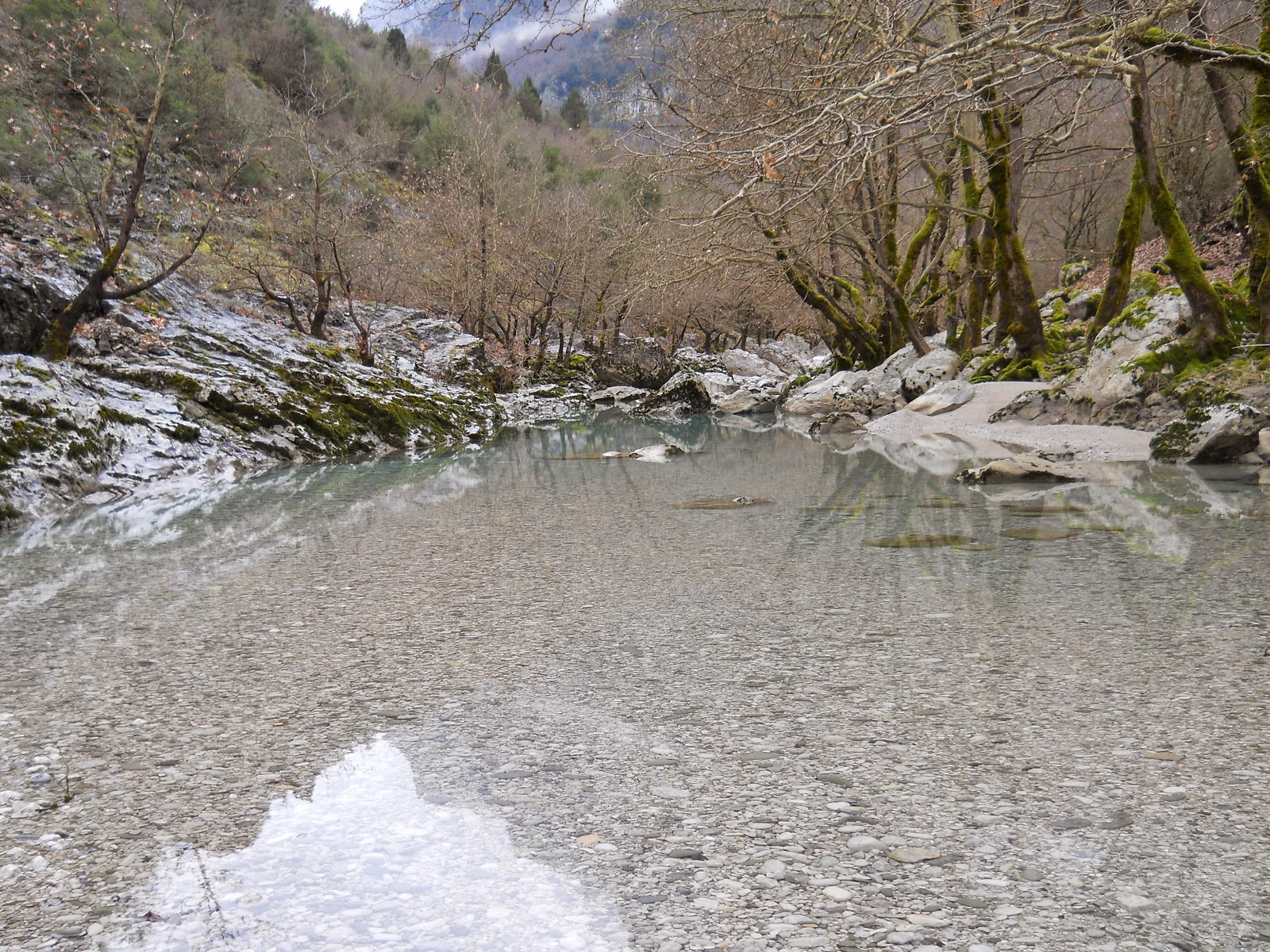
 The Voidomatis Spring. This river boasts being the cleanest in Greece. A perfect mirror, the water is a barely moving crystal clear that is arguably the most beautiful river I have seen.
 At the spring from Papigo you have two choices - Monodenri or Vikos. The gorge begins at Monodendri (which would be behind me in this photo) and ends at Vikos. I hiked up to Vikos.
The view from Vikos. Looking down at the Voidomatis river - can you see how blue that is? Pure, clean, tasty river water blue. 
 Part way between the spring and Vikos there is an old monastery, I took the side-path on my way back to Papigo. It seems to be abandoned and the doors were locked when I went but I know that people have been able to go inside and see the chapel. There were remains of recent fires so I think it is a popular stopping/camping spot!
 Voidomatis running along past the monastery. The progression of blues follows the depth of the water. Alpine vs Caribbean...which blue water do you prefer?
 Looking up at the towers
Along the hike there were many route maps for distance trail runs. I am happy that I got to hike these trails before any tourists or runners could clog up the trails!

Κοκκινο Λιφαρι - Red Rock
The hike to Red Rock was stunning but more relaxing than the hike to Vikos.  Beginning in Mikro Papigo, the trail hugs the rocky mountain and goes along headed south until you are under the last tower. Here, if you can believe it, is a large face of rock that is red!  I'm pretty sure the word for 'rock' in Greek is actually 'βράχος' but all the signs say what I have in bold above. One day I'll remember to ask someone, just not today.

 Path to red rock. Full of rocks!
Red rock itself. Hello, vertigo. 
 Looking across Papigo towards Albania. I think this is Gramos or Γράμος in Greek. Regardless the scenery is stunning.
The village of Megalo Papigo as seen from Red Rock. During the hike, while taking in the scenery and admiring the mountain looming directly overhead, I was able to see many of the horses' roaming grounds. In fact, I was able to keep an eye on the horses throughout my hike! Thank goodness for white horses!

Ρογοβο - Rogovo
A place I stumbled upon four years ago, this gem is a popular watering hole in the summer but blissfully peaceful in the winter - but bring a jacket. Rogovo is the name of the stream here and it is located between Megalo and Mikro Papigo.  What makes it famous and popular are the natural little pools that the stream has carved out over the years. 
A view overlooking the Rogovo spring. The water was pretty low due to very little snow and rain this winter - I hope it fills up for all the summer tourists!
Sarah sitting atop one of the bridge/dam things. We were exploring our way up to Mikro!
The formations are really something to see. All naturally formed, there are layers of rock that make climbing around quite easy. Just be careful its not too wet or slippery! Even the rocks which rise up around Rogovo, which are slate, are layered. 

Behind and Around Papigo
There may be names for some of these places, but on my walks and wanderings around I have not always stopped to read signs or asked where they lead. I prefer simply wandering.
Up behind the village, headed west, there is a dirt road and many small paths off that road that lead into open grassy areas and small, treed in fields. There is a tiny church and this lookout point here. There is a shrine inside also.
Prime example of some rolling hills. The village is in the background. A perfect grazing spot for the horses - often when they are back here they can roam all day without being bothered (by us or anyone else!)
View of the towers and the village from above the dirt road. From here (though not in this picture) you can perfectly see the stable and the goats if they are in sight.

That area between the Papigos
Fancy name, huh? This is one of those places where there is a sign...I have just never paid it any mind. Just before Rogovo, walking to Mikro, there is a pathway leading down into the valley between the villages.  Here there is a small river, old bridge, and some pretty neat spots.
Small river going towards the gorge! This water empties into the Voidomatis.
Beautiful little bridge, in a style that is common to the Zagori area, looking up to the towers. There are 46 villages in the Zagori but there is one, Kipi, I have always wanted to visit simply for their bridges! ...Next time.
Making the climb to Mikro.

Rides and Roaming Horses
Nothing here is complete without horses! Nothing much here but some lovely photos with my favorite 12 (11 now that Cassie has been sold off) horses and goats!
The girls
Leading a ride on Keravnos
Happily grazing horses
New HelpX, Kevin, with one of Ria's kids. He (the kid) seems to be resisting
Katerina with Ria's other kid, a little girl
This little guy is my favorite. He is smart, quick, bouncy and curious! And he has the sweetest little black boots on his legs!
And a video of two sweet little goats learning to run, jump and nibble!!