Tuesday, February 4, 2014

Shrews, Museums, Piazzas, oh my!

Padua (Padova in Italian) is known to me (and English professors everywhere) to be the setting of Shakespeare's "Taming of the Shrew".  My time in Padova proved to be quite the opposite...

I spent two days in Padua (about 20 mi from Vicenza) after I realized three things: there are so many things to see, it's too far to walk (and dark, useless for pictures) before the train leaves, and the museum card I purchased lasted for 48 hours! Perfetto.

Having some time to kill before taking the bus to Padua, I ventured across the street to have a macchiato and croissant.  Note that if you're ever travelling via bus or train from Vicenza, the cafe across has amazing coffee and espresso...and it is very, very reasonable! Said cafe is my official pre-day trip stop. MMmm.

****
Arriving in Padua right at the start of siesta and lunch break time meant that I was unable to stop at the tourist office for a map and museum ticket (the Padova Card) so instead I turned in a circle and took a guess at which way to walk....I may have gone slightly out of my way to get toward downtown but it was a lovely walk just the same! I noticed too things of note: the is a Blockbuster video store across from the train station (who knew?!) and I also passes the Trade Center memorial (I was unsure what is was but Jessica mentioned it later and *click*).

This memorial, "Memory and Light", was built in 2005 and inaugurated on September 11, 2005. It houses a beam, about 6 meters, from the South WTC.


 After stumbling upon this I found my way into the heart of historic Padua...right across from the memorial you'll find the old Roman arena, Scrovegni Chapel, and the Civic Museums (Musei Civici)!  At the museum entrance I was able to purchase my Padua Card and get the tour started.

First, the arena.  Padua or Patavium in Latin, was brought into the Roman empire around 45 BCE, being inhabited by the people of the region, the Veneti. Supposedly Patavium is dated back until Vergil's time and was founded by a Trojan (so roughly 1100-1130 BCE). Sadly the only ruin I came across (not in the museum) was the arena.  Scarcely standing and with a beautiful, grassy interior, Roman Patavium is certainly history!

With only walls to show, the arena in Verona is certainly more appealing, but Padua's arena is situated in a very nice garden.

Located next to the Scrovegni Chapel (my next stop), part of the arena was torn down to make room for the chapel and palace that was built for Enrico Scrovegni in the early 1300's.  Scrovegni, a money lender by trade, built his chapel for personal use. It is a popular (and likely very true) that he commissioned the chapel to atone for the sins of his father (also a money lender and guilty of usury).  Of course the chapel would also have been for his own after-life benefit!  Enrico's father was actually mentioned in Dante's Inferno for his sins (my guess is Scrovegni got one over on the poet...but I have no actual idea).

The chapel itself, though is famous for its frescoes.  Scrovegni hired Giotto to paint his chapel and they are very well preserved today.  Giotto's work is mostly known now for being well ahead of its time (his style became popular with the Renaissance).  Painting in the 13th and 14th centuries, Giotto's characters are startlingly life like and emotional - something very uncommon at the time.

Of course no photos could be taken inside the chapel (so I took this from the internet) but one wall is a painting of "the Last Judement".  Two walls are a series of stories from the lives of Jesus, the Virgin Mary, and the Prophets.  All situated under a blue, starry sky.  The colors in there are amazing!

Located right next to the chapel, the Civic museum and Eremitani plazza are sure to entertain the archaeologist, historian, and art lover for hours (even modern art)! I struggled to get through and see the things I wanted to see in good time (also slightly maze-like it is easy to get out of sorts).  I, of course, spent most f my time on the ground floor and outside with the Roman, Etruscan, and Veneti (and other local settlements) exhibits.  The best of all was a grave that had been dug up and moved - preserved amazingly, it was of a warrior and his horse.  The horses' backbone was wrapped around the man's skeleton!  So neat. 
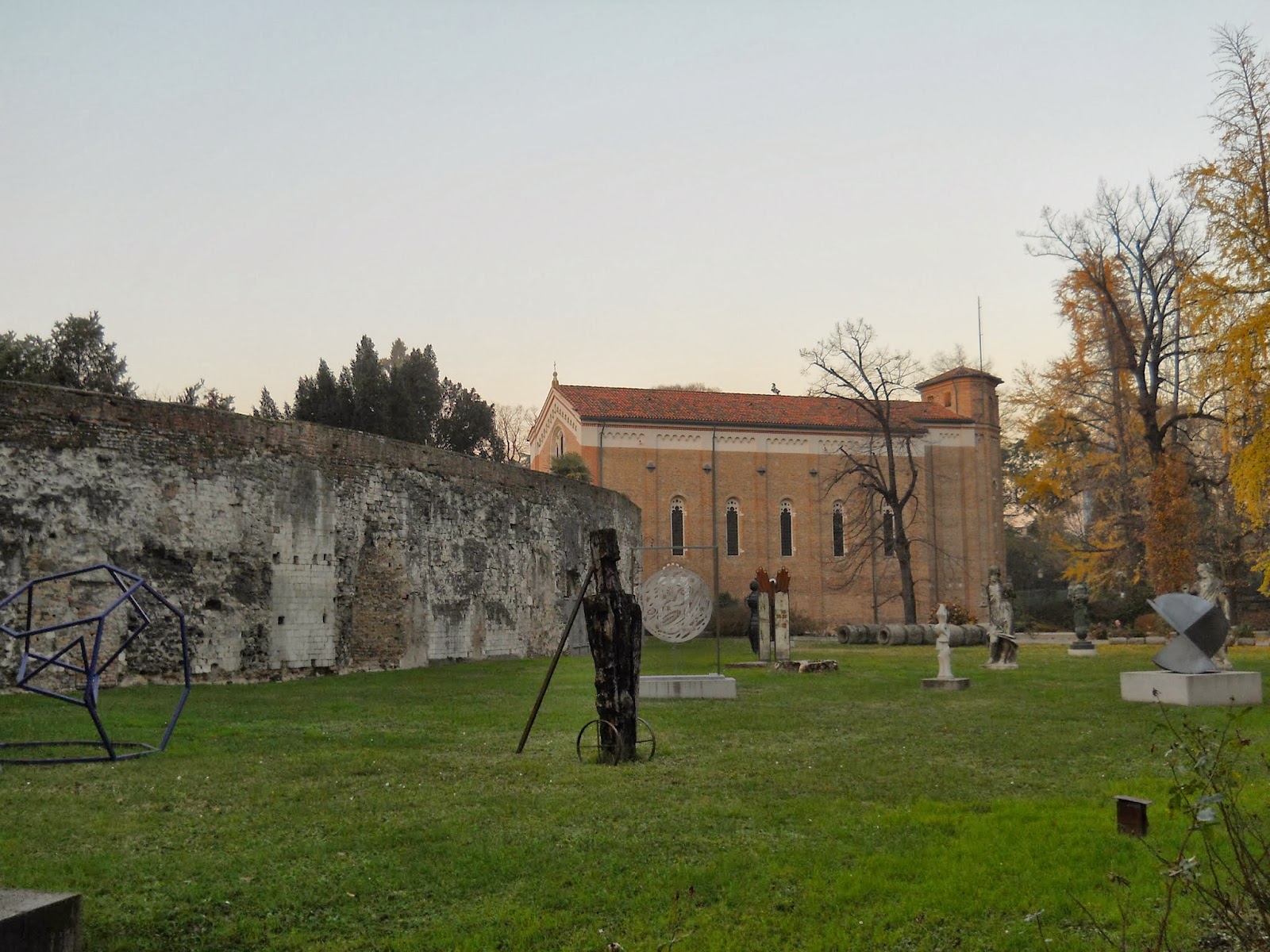
 A blend of modern art, Roman ruins, and a pre-Renaissance marvel - this is the courtyard of the Musei Civivi
Outside the Scrovegni Chapel


It was on the search for food and the other places my Padova Card would grant me access to that I realized I did not have enough time in one day.  The Prato della Valle, a large piazza I wanted to see very much (and preferably in daylight) was at least a 20 minute walk and the sun was already going down.  On the way, though, I walked  my way through some piazzas teaming with life (the piazza Garibaldi, piazza delle Erbe, piazza della Frutta, and the piazza dei Signori). Padova has one of the oldest universities in the world and students are everywhere! While I would not walk all the way to the Prato della Valle today, I was determined to see more than the Musei Civici!

A man playing his grand piano in the Piazza Garibaldi. He was quite good and was there for at least a few hours. I listened to him on my way into the piazzas and then again on my way back to the train station.

Coming into the piazza's Erbe and Frutti (and the smaller Signori) brought new energy to my trip to Padova - markets with food, sweets, clothes, handmade housewares, and jewelry covered both squares.  It was in the Piazza delle Erbe that I decided to sit down for a spritz aperol and some finger foods - but it was very difficult to decide where to go!  Browsing the markets I was able to find one of my favorite sweets - fresh nougat with almonds!
 Piazza delle Erbe. The building here is called the Palazzo della Ragione once housed the city courts. This side of the palazzo is the piazza delle Erbe and on the other side is the piazza della Frutta. This is the place where I sat down for a cocktail and to enjoy some sweets!
 Mostly artisan crafts in the piazza dei Signori. Smaller and more residential, this piazza was calm and warm - music playing from stalls and lights everywhere!
Piazza della Frutta. It used to be filled with markets of fresh food (mainly fruit by the name) but now it seems to be taken over by clothing! The piazza is lined with cafes and local hangouts for students.


DAY TWO in Padova

Not wasting any time today!  I walked straight back to the piazza Garibaldi and kept going through throngs of (protesting, partying, rabble-rousing?) students to get to the Prato della Valle.  This part of Padova is very touristy and beautiful.  The Prato della Valle is a large and open square (shaped like an oval) that is popular for students and business people eating lunch, hanging out, enjoying the sun, and of course, fresh produce stalls!  Around the square are two large and multi-domed churches - Santa Guistina Basilica and Saint Anthony's.
 Prato della Valle. Statues run around the entire area on both sides of the water. There are four bridges that connect the main square (where the food stalls are) with the park.
 Santa Guistina Basilica. So named as it houses the tomb of Saint Justina of Padua.  This basilica (and St. Anthony's) both have many Byzantine styled domes! Very cool architecturally and also a unique blend of styles.
Basilica di Sant Antonio or St. Anthony's basilica. This was open to the public and is a worth the trip.  You can go inside the basilica itself and it is very active (so dress conservatively and be quiet!) and is a popular pilgrimage stop. The grounds of the church has many smaller courtyards to explore, as well.


Other things about Padova that I wanted to see in detail but was unable to do because of Italy's siesta and odd business times...La Specola (observatory) and the Botanic garden.

Something I have learned about sightseeing in a Mediterranean country is to PLAN AHEAD. If it is not high tourist season (and sometimes even if it is) getting into places can be tricky.  Closed 4 days out of 7, the observatory (which I was willing to pay extra for!) was a far-off dream. With the botanical garden, I was a little more upset - the gardeners (or whomever) were leaving as I walked up at 2pm...they were supposed to close at 3pm according to all the signs. Rwar.

All the same, though, I loved Padova and will certainly return on my next Italian trip....and plan the day of the week based on the trickily timed sites. Though I found no evidence of shrewishness within the city (worn off from Shakespeare's time) I did have lots of fun watching multiple student gatherings, browsing markets and enjoying their fresh fruit and sweets, and counting the domes on the basilicas (I don't remember how many, sorry)!

 Statue of St. Anthony and tiny child (he is the saint of lost people) in one of many courtyards inside the basilica grounds.
 Amazing astrological clock in the piazza della Frutta!
 One of many side streets that is decorated for Christmas with red lights and a red carpet!
Prato della Valle with fruit stalls in front and the Santa Guistina basilica in the background.

Thursday, January 16, 2014

Note to the 'star-crossed' Lovers

Welcome to the city that harbored the salacious, violent and secret romance of Romeo and Juliet....Shakespeare style. Verona was the first day trip I took myself in Italy. A stunning city - closely put together downtown with lots of shops, touristy and tasty cafes, Christmas markets, historic stuff, and a central park that had lots of sweet street food trucks lined up!

 Entering the city gates from the train station!
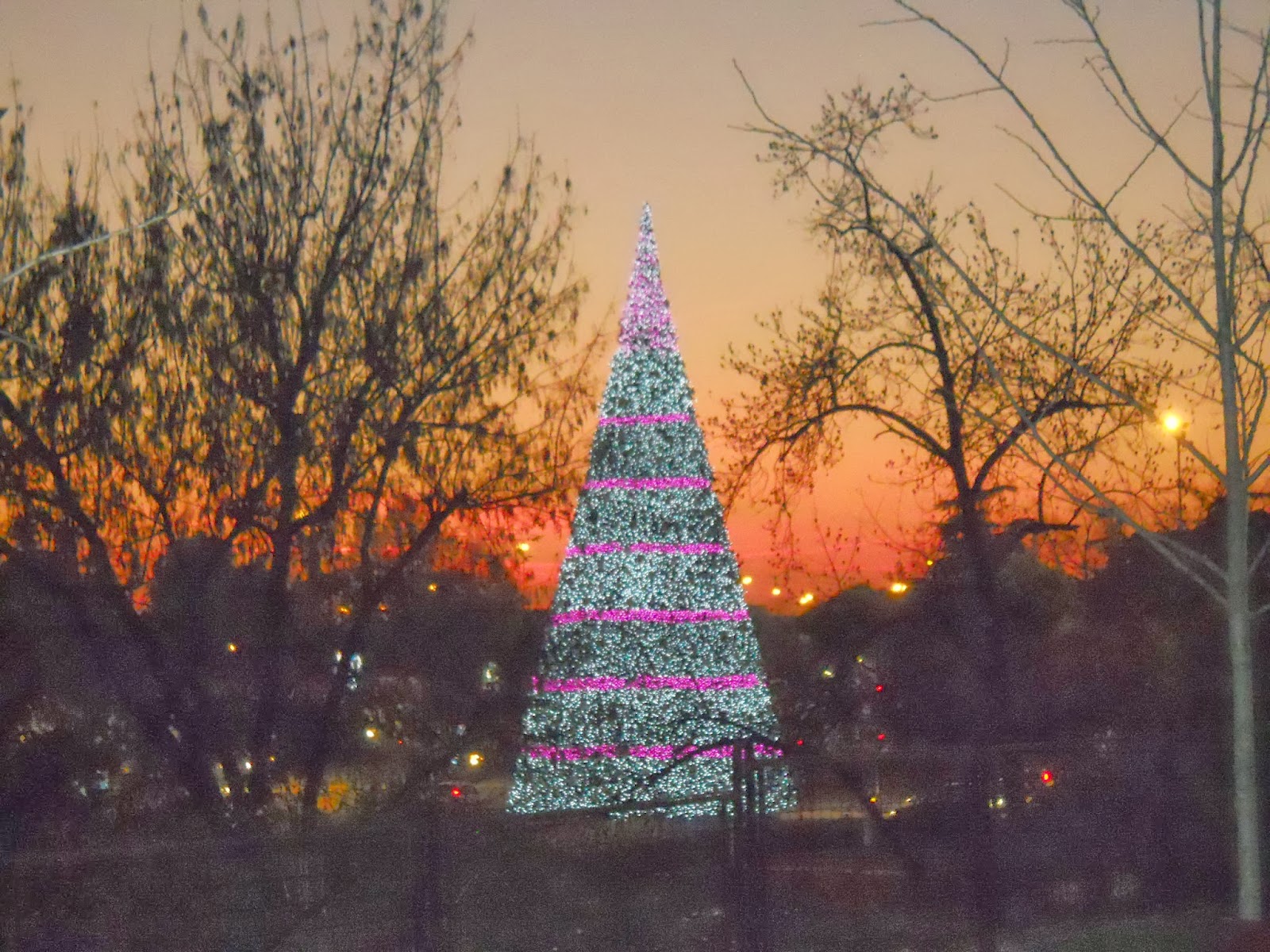
A bright, sunny (warmish) Christmas tree outside the old city gate.

I had a simple itinerary here - Juliet's balcony, a peaceful lunch with a good glass of wine, window shopping, and the Roman arena!

Juliet's balcony was my first stop - to get there I walked through the main piazza and through much of downtown.  While it is a magical place given its history, the balcony is NOTHING like it is represented in movies. Humph. Small, crowded (though not too much this day), covered in gum!  Nevertheless I decided to write a letter (which I will post here) and while I did not leave it, it being written was good enough.
 Teeny tiny balcony. I really hope Romeo didn't fall off! You can take a tour inside but I did not indulge. 
 Statue of Juliet. Complete with her boobs rubbed clean by those hoping for luck in love.  To the left is a multi-layered gate full of locks - people locking in their love.
Approaching the balcony and courtyard they have painted two walls white for people to write messages on.  They paint over the walls again when they are full.  Today the walls had lots of free space.
My letter and the notebook it came from.  The notebook is also appropriate - about a man going away and his lover tracing his profile on the wall to remember him by (the notebook was purchased in Belgium almost 7 years ago)! The "letter" is a series of quotes from the Persian poet Rumi who is said to be the first master of poetry and love. All translated from Farsi, of course.


After seeing Juliet's balcony and enjoying the awkwardness of watching people rub her boobs, I trotted off in search of a place to eat.  This ended up taking a long time since I stumbled onto Verona's Christmas markets and the main piazza on the way!

 Piazza delle Erbe. The original place of Verona's Roman forum! It has always served the city as its commercial center - the House of Merchants is here, too.
The Markets were held in small piazzas all off of the Erbe. The vin brulee was sweet and one even had a stand with oven-baked pizza! Though many of the wares were Italian food or made by Italians, there was so much German influence I almost forgot where I was.


The city of Verona rests (as most ancient cities do) on a river; here it is the River Adige.  The city is split between it - old city on one side and the new, more residential across the river.  I walked along the river on my way back to the Arena and the larger piazza and park, Bra. 

Beautiful day!
Locks, ribbons an little messages are locked on the cables over the river, too! 


Verona was established as a Roman city in the 1st century BCE.  Today it still boasts an arena and amphitheater.  Sadly I was unable to get to the theater but the arena, located in the large piazza Bra, is an impressive sight that has been married to the modern world via monument for the Christmas season. Named the stella di Natale, and described as a comet of Christmas, this monument is on display with the arena from November 30th - January 26 2014! 

 Stella di Natale and Arena from the piazza Bra
 I met a lovely couple inside the Arena an we exchanged picture-taking roles! Later on in my Roman exploration I met an Indian couple living in Canada and they asked me to record a video of the arena describing what it was used for, when it was built etc. Kind of cool but I wish I'd read up on Roman Verona!
Original outer wall...so pretty in the sunlight!

 Piazza Bra from atop the Arena. So much junk food to choose from it was a wonder I sat down for an actual meal! I did eat here (off to the right with awnings), a complete (if slightly typical American) pizza with mozzarella and prosciutto and a large glass of red wine!
Mmmmm, street food.

 the hills outside Verona at the beginning of sunset, seen from the Arena
 Creative drawings in the sand...clearly the work of fierce gladiators. Good to know somethings around the world are always the same...doodles are never that different, are they?
Leaving Verona, all set for Christmas! It must be said that I had some fantastic gelato on my way back to the train station. I had green apple and chocolate (of course). The apple was tart, sweet, and contained bits of apple. Mmmm. Good way to end the day.

Saturday, December 7, 2013

Berlin, Potsdam, Dresden...oh my!

I spent two weeks in Germany living in a small village.  Thanks to the generosity of my hosts I was able to get out and see two wonderful cities (and a little bit of Berlin on my own before I arrived).  They are in the order I visited them in.

- BERLIN -

Berlin is a sprawling city but almost all of the main sites and attractions are grouped together... I saw them from a car as I drove to the train station. The driver was kind enough to take some detours for me!  What sticks out most, though is a street.

This street, located in the central area of Berlin in the Tiergarten (or animal garden), is called "John Foster Dulles Allee" - John Foster Dulles Avenue. It's situated in a lovely urban park that passes many of Berlin's sites and current political buildings.  At first I thought it was odd for a street to be named after such a prominent American (then I thought about it).

Berlin was the capitol of Nazi Germany in WWII and this section of Berlin happened to be in the West of Berlin when the Wall was built.  J.F. Dulles hated communism and funded Nazi Germany during the 30's....mystery solved. I had the itching desire to somehow desecrate the sign.

My opinion on Berlin -
-Absolutely go to see the sights and enjoy, they are beautiful and interesting
- Its expensive to eat, stay, and get around on public transport.
- Though the sites and history is very worth seeing I would not bother going outside of the main area unless you're goal is to see a big city with people commuting.

- POTSDAM -

My day in Potsdam, sadly, was rainy and chilly but approaching the Christmas season most cities in Germany are bustling in some way!  Kerstin had an interview in Potsdam and we were meeting Hui Man at the train station to take her back to Hohenleipsich that afternoon.  I got a great feel for the city before I went inside to warm up and shake the rain off my jacket.  The center of the city is small and easy to navigate. 

I explored two areas in particular - the Dutch Quarter, or Hollandisches Viertel (umlaut over the 'a') and the Old Square, or Alter Markt.  Both are popular tourist areas and are next to each other.  In this area there is a main shopping avenue, one of three remaining city gates, the Potsdam museum, the church of St. Peter and Paul (they were erecting a Christmas tree in front!), Nikolaikirche, the filmpark Babelberg, and the newly rebuilt City Palace (Potsdamer Stadtschloss) which was rebuilt with the purpose of housing their Parliament. Potsdam is the capitol of Brandenburg.


Church of St. Peter and Paul in the Dutch Quarter.  The first Catholic church to be built in Potsdam in 1867, it is located off the Brandenburger Strasse (main shopping street). The trucks in the foreground are setting up for a weekly market - the rain didn't dampen their spirits too much. 

City gate Nauener Tor.  Built in 1733 then re-designed in 1755.  Originally there were 5 city gates but only 3 remain today: the Nauener, the Brandenburg (just like the one in Berlin, but smaller and older), and the Jagertor (Hunter's gate).

The Dutch Quarter has 134 red brick, 3-story houses (though they are tall, they are not so narrow as their Dutch counterparts) that were built by and for the Dutch moving to Potsdam mostly to practice their crafts.  Potsdam (Prussia at the time) was very religiously tolerant and had a large number of immigrants - Dutch, French, and Jewish!

The Potsdam Museum, my shelter and warmth from the rain! The museum is mostly in German with the overall explanations and displays in English.  Thankfully it was unnecessary for more to be translated. The museum covers a lot of stuff so I was unable to see all of it at my pace (I can easily spend hours in a museum) but I was lucky and the stuff I like most - military history, history of Prussia, the kings, residences, and state of Brandenburg through principality, Prussia, WWI/II was at the beginning!

Potsdamer Stadtschloss. This was not taken on my rainy day. Sadly there was very large amounts of construction around the palace so I could not get a single picture of the castle.  This is the reconstruction, where the Parliament will be (they have yet to move in).  The dome in the background is of Nikolaikirche and the building on the left foreground is a Hotel Mecure.  It seems Brandenburg considered tearing the hotel down along with the reconstruction because it disturbs the aura of the palace (the hotel is not attractive, having been built in the 70's).

Potsdam is home to large and beautiful parks.  Kerstin and I packed a picnic lunch to eat with Hui Man but the weather was not good enough to eat outside! Shame, because the park had softly rolling hills an was so green. Also it had this neat little statue at the beginning...
Three naked, happy people enjoying the greenery. 


- DRESDEN -
I visited Dresden three times during my stay in Germany. Dresden has a rich history. I became interested in visiting when I first learned about the fire bombings of 1945 while I was in high school (and later when I read "Slaughter House 5" by Kurt Vonnegut my interest was renewed).  Like most old cities Dresden has a New and Old city center (Neustadt and Altstadt).  I spent most of my time in the old part of town; but there are historic sites, markets, and quaint squares in both parts of Dresden.
Dresden is split by the river Elbe and lies in a valley. This is part of the skyline of old Dresden - I am on a bridge that crosses the Elbe.

My first time in Dresden I walked about just getting a feel for the area - I was only there for about 2 hours while Kerstin was working.  The city center in the old town is lovely, especially since Dresden was preparing for their annual Striezelmarkt - Christmas is a very serious thing here! Lots of open space filled with shopping, cafes, and the best street food you can imagine - rostbratwurst!

Here is a quick line-up of the best places to see in (Altstadt) Dresden:
- Frauenkirche (Church of Our Lady)
- Neumarkt Square
- Semper Opera House
- Zwinger (also known as the Japanese Palace)
- Procession of Princes 
- Altmarkt Square (where the main Christmas market is held)
- Kreuzkirche (I did not go inside here but it overlooks the Altmarkt)

Frauenkirche. The church is located in the midst of Neumarkt Squre.  This church was mostly rebuilt after the 1945 firebombing. 
Part of Neumarkt Square. A quaint place with variety! Chocolate shops, restaurants, shops, apartments above, performers and artists in the square and Christmas decorations being set-up!

Semper Opera House, Germany's most famous Opera. The building (originally built 1838-41) was completely destroyed in 1945 and the new building was completed in 1985. It is home to the Saxon State Orchestra. 

The Zwinger, or Japanese Palace, surrounds a large rectangular courtyard. At one end (shown here) the building has a glockenspiel. This is a particularly neat one because instead of ringing it chimes. Every 15 minutes it has a slightly different chime that is so pretty! It's bells are more similar to hand bells. The Zwinger was built in the early 1700's. The courtyard was designed to be used as an orchard of sorts and for festivals.  The building was mostly used for exhibitions and collections. Today it is still a  museum.

 The procession of Princes is a mural that shows the Wettins, Saxony's ruling family. They are all depicted on horseback like a Roman military procession. It is located on the outside of a building belonging to the palace complex.

The Altmarkt has a square and a large gallery (think shopping mall). The square is where Dresden holds its Striezelmarkt so I was not able to get a photo of the square itself. The Altmarkt gallery surrounds it and was lined with lights. A very beautiful sight a night!

Kreuzkirche. Home to the Kreuzchor boys choir (700 years old!). Heavily damaged in 1945, the tower is visible over the Altmarkt and provides a panoramic view of the Elbe and Altstadt.

 - STRIEZLEMARKT -

I ended up prolonging my stay in Germany in order to catch the beginning of Dresden' Christmas market which began November 27th. It was cold but very cool to see! The market is in its 579th year, having begun in 1434 (making in 342 years older than the United States). Kerstin and Carsten took HuiMan and myself. It was a night of gluhwein, bratwurst, lots of snacks and window shopping!

Quick history... The Dresden market is the oldest in Germany and is now the most popular. It began in 1434 as a one day market instead of the month long affair it is today.  There are over 240 vendors at the market with all sorts of wares but the main staple of the market is, and always has been, the Christstollen - the traditional Dresden Christmas cake. The name "striezelmarkt" came from the cake.  In medieval German "striezel" meant a yeast-risen pastry (there are raisins in the cake too).  The official cakes are baked by members of a Dresden bakers' guild and they use the same traditional recipe! Of course there is lots of gingerbread and gluhwein (hot mulled wine) too!
Christmas tree! Front and center of Alt markt square
 Overlooking the striezelmarkt. Carousel, ferris wheel, and lots of stalls. 
 So I asked what they call these and it was nothing specific. In fact I think Kerstin may have said its just a 'tower'. I know my aunt has a small one and they are really quite lovely. This one was gigantic (as opposed to the little one that my Aunt has sitting on a table)
 The whole shopping area was decked out, too, with lights everywhere! Very romantic and scenic. 
 This vendor owner took "stall" to an epic level. He built a cottage complete with two sets of doors to keep it toasty warm inside. There was even a section of the table where anyone could roll out some dough and cut out cookies! It smelled AMAZING.
Just one example of things for sale. Many of the wares take a lot of skill and time. The Striezelmarkt is not to be compared to a flea market or carnival. All the wooden scenes are hand carved, burned, and/or painted. 
And of course, my favorite, gluhwein! They even come served in a mug that has the founding date and "Dresdner Striezelmarkt" on it - the official cup!
HuiMan, Kerstin and I
At least HuiMan was ready for the photo! Enjoying our wine.

Enjoy some pictures!
mmmm...rostbratwurst. By far the best street food I've had!
All the mugs waiting to be filled with gluhwein
During the market HuiMan stopped to try and pronounce this word...in German they (almost) literally put words together to make the one they need. It's a tasty fried, very light potato pancake but they serve it with sugar on top. It sound a bit odd but was actually very tasty. 
Overlooking the courtyard at the Zwinger. It was cold up on the terrace but provided a great view of Dresden's skyline and the Zwinger.
There were lots of horse carriages about! These two were so sweet and kept cuddling their noses together.